

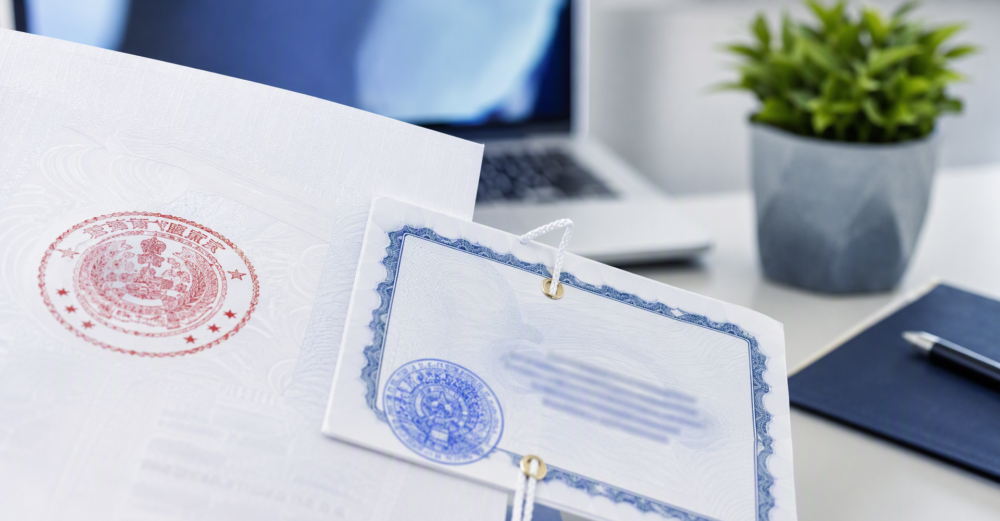
If your company imports medical devices from China, you will soon face a key procedure: the certificate of free sale and other documents issued in China must have official validity in your country before you can file them with the health authority. The question every company asks is whether this requires consular legalization. The short answer: in most cases, no longer.
Apostille, not consular legalization
China has been a party to the Hague Apostille Convention since November 2023. This means that if your country is also a party — such as Costa Rica, Mexico, Colombia, Peru, Chile, or Argentina — Chinese documents do not require consular legalization: an apostille is enough. This procedure is faster, simpler, and less expensive than the traditional consular route. Only if your country is not a party to the convention does consular legalization remain the applicable route.
What is the apostille and how does it work?
The apostille is an official stamp or label certifying that a document’s signature and seal are authentic. In China, it is issued by the Ministry of Foreign Affairs and the authorized provincial foreign affairs offices. The usual process has two steps: first, the document is notarized before a Chinese notary; then it is submitted for the apostille. With that, the document becomes officially valid in any member country of the convention, with no additional procedures in China or at your country’s consulate.
How long does it take?
As a general reference: notarization takes one to three business days, and the apostille takes between three and seven business days depending on the route used. To that, add the physical shipping of the document between cities and, if applicable, international transport to your country. All in all, it is reasonable to plan for two to three weeks door to door. Exact timelines depend on the type of document and the city where it is issued, so it is best to confirm them before committing to registration deadlines.
Why it is critical for medical devices
To register a medical device with your country’s health authority, the certificate of free sale issued in China must be filed with an apostille — or legalization, depending on the country. Without this step, the authority will not accept the application: the registration stops, and your product’s market entry is delayed by weeks or even months. In addition, these certificates have limited validity, and a procedural error can force you to restart the process at additional cost. Planning the apostille from the very beginning of your registration project is one of the simplest ways to protect your commercial timelines.
A process best left to experts
At Lafa Legal, we coordinate the notarization process with your supplier and handle the apostille of documents in China, with follow-up in Spanish and coordination with your product’s registration timelines. If you are preparing the sanitary documentation for a medical device, write to us and we will confirm the exact procedure and timelines for your case.
— Lafa Legal | Legal and commercial advisory in China for Latin American companies