

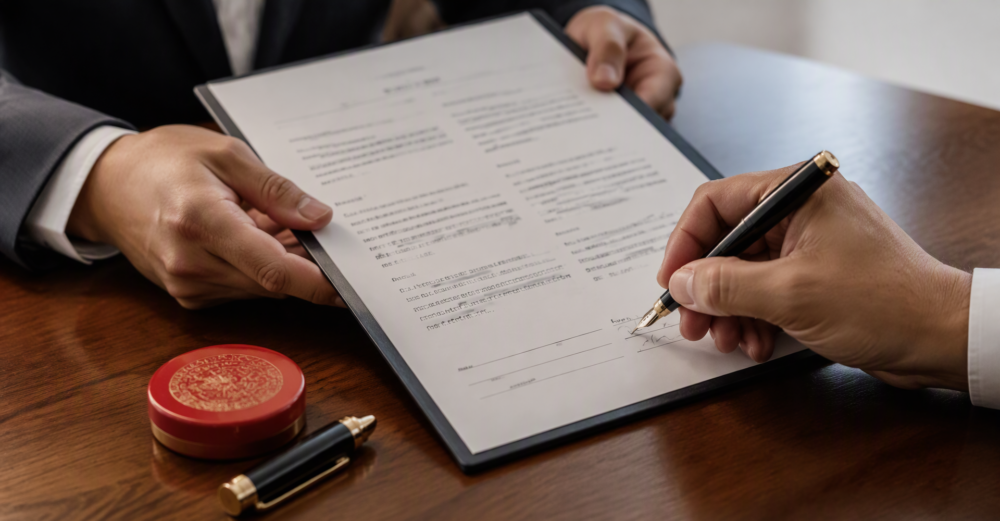
A proforma invoice, by itself, does not protect you. If you are about to sign with a Chinese supplier, the document you sign today will define how many options you have tomorrow when something does not go as agreed. And in international trade, the difference between a solid contract and a worthless piece of paper usually comes down to a handful of specific clauses — and one decision most buyers postpone: where disputes will be resolved. This guide covers both, in plain language, so you can negotiate on equal terms.
The clauses your contract cannot omit
1. Exact identification of the parties. The contract must state the Chinese company’s full legal name exactly as it appears on its business license, together with its unified social credit code. An acronym, a trade name, or an English variant is not enough: if the party is not identified precisely, the contract may be unenforceable.
2. Scope and technical specifications. Product, model, materials, dimensions, tolerances, quality standards, and required certifications. What is not written does not exist: if your market requires certain certifications — such as sanitary certifications for medical devices — include them as a contractual obligation, not as an assumption.
3. Price, currency, incoterms, and payment terms. Unit and total amounts, payment currency, agreed Incoterm (FOB, CIF, EXW), and milestone-based payments. The industry-standard combination is a 30% deposit and 70% against shipping documents, always to a corporate bank account in the exact legal name of the contracting company.
4. Deadlines and late-delivery penalties. Production and shipping dates, plus a late-delivery penalty (generally a percentage of the order value per week of delay, with a cap). Without this clause, a supplier’s delay carries no consequence whatsoever.
5. Quality control and pre-shipment inspection. The right to inspect the goods before shipment, by you or by a third party, with clear acceptance and rejection criteria. This clause is your only real opportunity to fix problems before the container leaves China.
6. Warranties and liability for defects. Warranty period, obligation to replace or compensate, and the procedure for claiming defects discovered at destination.
7. Dispute resolution. The clause that decides everything, detailed in the next section.
8. Language and hierarchy of versions. The contract should be bilingual — Chinese-English or Chinese-Spanish — and explicitly state which version prevails in case of discrepancy. Signing only in Chinese means giving up the ability to know what you signed.
9. Communications and notices. Official channels valid for demands and notices, with email addresses and physical addresses. In a dispute, being able to prove that you served notice correctly is worth its weight in gold.
Where are disputes resolved?
This is the question with the greatest consequences, and the one most underestimated. There are three main options:
Negotiation and mediation. The usual first step. When there is a clear contract, most commercial disagreements are resolved through a formal claim and direct negotiation. It is the fastest and cheapest route, and the contract should provide for it as a preliminary step.
International arbitration. The professional option par excellence. Instead of a state judge, a private arbitral tribunal issues a binding award. The venues most used for disputes with Chinese suppliers are CIETAC (in mainland China) and the neutral seats of Hong Kong (HKIAC) and Singapore (SIAC). The great practical advantage: thanks to the New York Convention, around 170 countries — including China and the Latin American countries — have committed to enforcing foreign arbitral awards. In other words, an arbitral award won in Hong Kong can be enforced against the Chinese company’s own assets, something extraordinarily difficult with a foreign court judgment.
State courts. Chinese courts can be chosen. In practice, litigating in Chinese courts as a foreigner requires time, costs in preparing the evidence, and local representation.
The mistakes that void a contract
- Sign without verifying that the contracting company is the same as the one on the bank account.
- Not disputes clause.
- No penalties or inspections in advance.
- Relying on chat captures instead of a signed and sealed document with the company’s official red seal.
A well-negotiated contract is your best insurance
No clause eliminates the risks of international trade, but a well-structured bilingual contract radically changes your position: it gives you arguments in negotiation, tools when something fails, and a clear path to demand what was agreed. In practice, serious Chinese suppliers respect and value well-made contracts, because it also gives them security.
At Lafa Legal, we draft and review bilingual contracts for Latin American companies doing business with China, with local lawyers who know both commercial realities. If you are about to sign with a Chinese supplier, write to us before putting pen to paper: reviewing a contract takes days; undoing a bad one takes years.
— Lafa Legal | Legal and commercial advisory in China for companies around the world.