

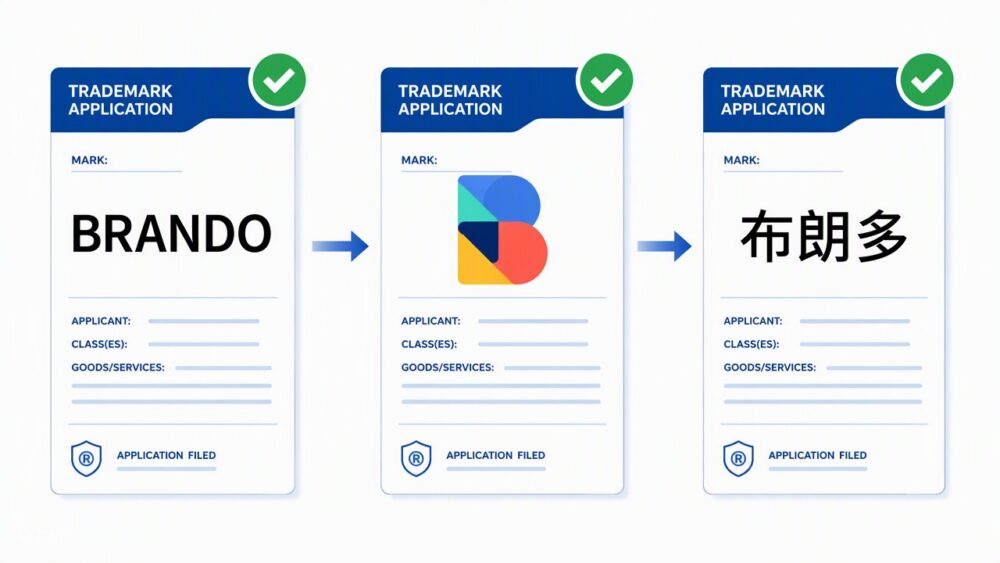
Expanding a business into China is a major opportunity, but it carries risks if brand identity is not protected in time. One of the first questions when planning a filing is: should you apply for a word mark, a combined mark, or both? The short answer is that both are fully registrable before the CNIPA —China’s intellectual property authority— but they protect your brand in very different ways. This article explains the differences and the strategy IP experts recommend.
What does Chinese law say about trademark types?
Under Article 8 of the Trademark Law of the People’s Republic of China, any sign capable of distinguishing the goods or services of one enterprise from those of others may be registered as a trademark. The law expressly lists words, devices, letters, numerals, three-dimensional signs, color combinations, sounds, and combinations of these elements. This means both the word mark (文字商标) and the combined mark (组合商标) are fully valid legal figures.
The difference, therefore, is not one of legitimacy but of scope, risk, and flexibility.
Word mark: protection for the text itself
A word mark consists solely of text —Chinese characters, Latin letters, numerals, or a combination thereof— with no graphic design. Examples include marks such as “NIKE” or its Chinese-character equivalent “耐克”.
Its main advantage is flexibility. By registering the word, protection covers the text regardless of the typeface, color, orientation, or design used later. If the company rebrands two years from now, the name remains fully protected. In addition, because there is only one element, the CNIPA conducts a simpler examination with a lower risk of refusal: there is only one component to compare against prior marks and one distinctiveness criterion to assess.
When a word mark is not enough
There are two situations where text-only registration may fall short. First, when the chosen words have low distinctiveness —for example, descriptive terms of the industry— and need a visual element to pass the substantive examination. Second, protected text does not cover the logo: a competitor could use an identical graphic design with a different word without infringing the word mark.
Combined mark: visual power with strict conditions
A combined mark merges verbal and graphic elements in a single application. It is the most widely used format in commercial practice because it is striking, memorable, and easy to associate with the company. However, registering it in China involves risks worth knowing before filing.
Examination by separate elements
Although the combined mark is filed as a single application, the CNIPA examines each element independently. If the text or the graphic element is similar to a previously registered mark, or if either lacks distinctiveness, the entire application is refused. This significantly raises the refusal rate compared to a word mark.
The obligation of exact use
Another critical point: once approved, the combined mark must be used exactly as registered. Its elements cannot be split up, rearranged, or resized without falling into irregular use of the mark, which can weaken its validity against third parties.
The recommended strategy: separate filings
In practice, the standard recommendation —especially relevant in China, where the first-to-file principle applies— is to file separate applications for every element worth protecting: the word mark, the logo, and, where applicable, the version of the name in Chinese characters.
- Risk containment. If the logo conflicts with a prior mark, the word mark can still be registered, keeping its filing date.
- Segmented protection. Each element is protected independently, making it easier to enforce against infringers who copy only the name or only the design.
- Flexibility of use. The company can combine or separate the elements in its commercial communication without fear of irregular use.
Conclusion
Both the word mark and the combined mark are registrable in China, but they serve different functions: the former offers flexibility and lower risk; the latter locks in the exact visual identity of the brand. The most robust option is not to choose one over the other, but to file them separately, so every element of your company’s identity is protected independently against any examination contingency.
If you are planning to register your trademark in China, run a clearance search in the CNIPA database first and consult a local trademark agent to define the strategy that fits your budget and target markets.